Dublin 2003, Celtic history and the Rock of Cashel Tue, Feb 25. 2003
In February we visited Ireland so Niamh could meet the European side of the family. I dubbed the trip Niamh's Euro tour 2003. Although it was a long journey to and from, Niamh travelled very well for a lass of less than three months old, passport in tiny hand. We arrived at Betty and Michael's home in Donaghmede, a suburb on the North side of the city, in the area known as Dublin 13 (based on the city postal code numbering system). Our first visit was to Lily Dunne, Niamh's great grandmother (Betty's mom) who lives in a flat in the city center. I got a wonderful photo of the four generations while we were there.Dublin in February is typically cold and rainy as one would expect, but all things considered, the weather was quite mild. We took a rainy day trip into Dublin and had a late lunch at Oliver St. John Gogarty's in Temple Bar, which was a return to the location of our rehearsal dinner, and featured about the biggest smoked salmon appetizer I've ever consumed. I hardly had room for the main course. I advised against it, but Niamh insisted on ordering her first pint of Guinness. After downing the pint, she ordered a second, but settled in for a nap after only one sip (how wasteful). Well I had no choice but to finish it off for her.
After a few days in Dublin we took a trip out to visit Tracy's Aunt Marion and her boyfriend Shay in their new country home near Carlow about an hour and a half or so drive from Dublin. We arranged to meet in the town of Baltinglass at "Quinn's". As we'd gotten somewhat lost, and were hurtling down the narrow country road's at dusk, it was quite a relief to finally find signs for the town. Baltinglass is a market town for Wicklow county, where cattle and sheep are sold. In other words, this is what you think of as traditional mid Ireland countryside. We made our way into the town, and almost immediately I saw a sign and yelled out "There's Quinn's" only to realize as we passed it, that it was Quinn's hardware, next to Quinn's grocers, adjacent to Quinn's hair salon. We crossed the bridge, and passed numerous other Quinn owned establishments. Eventually we found Quinn's pub, and on the assumption that this was the right Quinn's entered, and sure enough found Marion waiting for us. After some soup and a few pints, we proceeded out to their home, recently acquired.
Shay cooked a nice dinner for ourselves and his friends from work Johnny and Bronagh, who had an 18 month old boy named Rory. Watching Rory in action, I began to appreciate more fully the benefits of having a daughter. Rory who had bump the size of a squash ball on his forehead (having ran into a wall the day prior) proceeded to charge about the house for the next several hours, either starting up, or pulling the knobs off of any electrical appliance he could lay hands on, and shutting a door on his fingers at one point. Rory found Niamh to be quite interesting, and when given a chance pulled off her sock, yelled out "Bah Bah" and squeezed her toes. Boys will be boys, as they say.
The next day I took a few photos of the house. One of the things I noticed was the grating at the beginning of their driveway. This grating covers a trough, and I was informed has the purpose of keeping wayward livestock from entering the property, since they won't pass over the grill. You know you're in genuine Irish countryside when your house has a livestock grate, I think.
Prior to heading back to Dublin we took a drive out to a local monastic retreat, and walked around the grounds. Although it was quite cold, Niamh took a nap safe from the elements inside Aunt Marion's coat.
After spending some more time in Dublin, we took a trip out to Cork which is about a 4 hour drive South. Along the way we stopped off in Tipperary at the Rock of Cashel. To understand the significance of the Rock of Cashel, you need a bit of Irish history.
In the first centuries AD, Ireland was ruled by a series of warring celtic clans. Celtic culture was the predominate culture of europe, mainly because the Celts had mastered the production of iron. Over time Celts spread to the Pretanic (British Isles) and either assimilated or conquered the indigenous populous. Things remained that way through one thousand AD despite the rise and fall of the Roman empire which supplanted Celtic culture in the rest of Europe, probably because the Romans never invaded Ireland. Celtic society held sway within Ireland and the Irish warlords eventually came to control parts of Northern Britain and Wales. What held together and bound the Celts of Ireland was their common culture and language.
Celtic society revolved around war, and the control of small kingdoms. An overlord would exert control over smaller kings, and a "High King" was really just an overlord who controlled a large region of land. With the ebb and flow of clan power, there were at any particular time from 4 to 10 major regions dividing the Island, each with a High King. Neighboring clans would ally with or against their neighbors and battle for control of territory. War was a major focus for the warriors, ironsmiths, and poets who represented the upper class of Celtic society. For the average peasant, whose life was spent farming or raising livestock, while they were ultimately "owned" by whichever family controlled the territory within which they live, the constant regional strife had little effect on their day to day activity.
In the 300-400AD period, the Eoghanachta clan from Wales managed to conquer most of the southernmost of the six regions of ancient Ireland, known as Munster. In doing so, the Eoghanachta's became the kings of Munster. The rock of Cashel was built upon a jutting hill of stone in the middle of the Tipperary plain as the fortress for the Kings of Munster. Cashel literally means fortress, and the Rock of Cashel is one Ireland's most famous fortress castles, easily seen from miles away.
In 430 the pope sent the first missionary Palladius to be Bishop of Ireland. He was followed by numerous missionaries and eventually by St. Patrick who arrived in probably around the year 460. Although the historical accuracy of St. Patrick's legacy as the individual responsible for the conversion of Ireland to Catholicism is open to debate, his import to Irish tradition is profound. Born in Wales, St. Patrick was captured and enslaved in Ireland as a young man, where he was forced to tend sheep, and during this period underwent a spiritual conversion to Christianity.
He escaped six years later, literally walking 200 miles to the coast, and managing passage to Gaul where he trained to be a priest. As legend would have it, he often dreamed of Ireland, and returned to the island as a missionary, credited with popularizing the use of the shamrock as a tool for explaining the concept of the holy trinity to potential converts.
St. Patrick is purported to have visited Cashel in 450 (although that would be hard to do if he only arrived in 460), and in a meeting with the Munster king accidently stabbed him in the foot with his walking stick. For reasons unknown, this event lead to the clan's conversion to Christianity, perhaps because the King considered this a rite of conversion. A large Stone cross was erected to commemorate St. Patrick's visit, and Cashel became an important Christian destination, with a Cathedral and chapel built upon the grounds in subsequent years.
In all probability, the real reason for St. Patrick's success was his knowledge of the language and traditions and his own heritage as a Celt born in the British isles. He did not look upon the people of Ireland as pagan's or heathens, but rather as fellow countrymen, and he fearlessly sought conversion of key nobility and encouraged local converts to take positions in monasteries and clergy.
As these monasteries and churches were built across Ireland, one of the important missions they brought with them was the creation of the monastery town. As a monastery was built, a town would develope around it, to provide the crafting and labour required to house and feed the monks. Prior to the monastic system, there were only villages or forts. These monastic towns became the evolutionary building block of Irish society bridging the gap from the Celtic clan tradition to modern society.
Monasteries were also important as incentive for the Viking invaders. In the 9th century Ireland was invaded by Norwegian Vikings seeking slaves and items to pillage. Unlike the small scale attacks that had begun centuries earlier, these were large scale incursions, perhaps by displaced Viking nobleman looking for a land with more agricultural promise than their oft frozen homeland. One such incursion lead to the reinforcement and buildup of a Viking encampment at Dublin. Many Irish coastal cities (Cork, Wexford, Howth, Limerick and Waterford for example) were all originally Viking encampments (the ford suffix comes from the norse word fjord, for example).
Since Monasteries represented the largest accumulation of wealth and populous in Celtic Ireland, the Vikings found Monasteries to be a good source of wealth and slaves.
Dublin became the center of trade for the Viking world, and eventually the largest and most important city in the country. Although they never conquered Ireland entirely, the Vikings became entrenched and indistinguishable from the native Celtic clans. They were also never entirely driven out, as many Viking clans in essence settled in Ireland, even converting to Catholicism.
As Invaders with a military organization, the Vikings were in so far as history is concerned "defeated" by Brian Boru, who had won control over Munster (and thus Cashel) on his way to becoming the only Celtic warlord able to make legitimate claim to the throne of High King over a united Ireland. Boru layed siege to Dublin and won a bloody battle at Clontarf, a plain to the North of Dublin, which cost several thousand lives, and in the process drove the Vikings from the city onto their ships, leaving Ireland's largest and most important port under control of the Celts. Ironically Brian Boru was killed at the battle, as legend has it, having been hacked to death in his tent by an axe wielding Bezerker. Though probably not historically accurate, the battle of Clontarf is considered the final defeat of the Vikings by the Irish.
The Rock of Cashel is a wonderfully preserved site, with a history that connects many of the great historical and legendary Irish figures. It's root predate the rise of Strongbow as the first non Celtic King of an Irish province (signaling the immersion of Ireland into Anglo Norman conflict) and is also known as the infamous site of a massacre of over 800 townsfolk at the hands of Oliver Cromwell's army in 1647. It's a place you simply must visit if you're making a trip to Ireland.
Eventually we arrived at our coastal destination, The Maryborough hotel. From there we proceeded to spend a day in the town of Kinsale, known according to Shay as the "Gourmet capital of Ireland" due to the numerous and various restaurants (actually out-numbering pubs!) and scenic bayside views. We began our visit with a stop at the star shaped Charles Fort, built by the English to protect against naval invasion in 1677 and occuppied by a garrison until the early 20th century.
While Kinsale was beautiful and scenic, I wouldn't recommend visiting in february, as the town is at it's peak in the summer months, and home to a world famous regatta in August, and a gourmet festival in October.
After a pleasant and relaxing stay in Cork, we returned to Dublin and yours truly turned another year older on Valentine's day, with a pleasant meal at a Dublin restaurant with Tracy's brother Ian and wife Jean, Shay and Marion, and friends Tracy and Finton Carroll who took a break from renovation of their new house in Malahide to join us.
It was once again a great trip and I look forward to visiting again soon, and seeing and learning more of the country, as well as friends and family. After that visit I would not be surprised if the first word to pop out of Niamh's mouth was "Grand".
Double crossed Thu, Mar 14. 2002
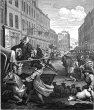
In the early 18th century the city of London with a circumference of roughly 36 miles, was home to some 600,000 people despite the lack of modern plumbing, crime enforcement or medicine. The extent to which corruption, vice and crime were institutionalized inspired the works of contemporary authors like Charles Dickens, Jonathon Swift, Daniel Defoe and Henry Fielding. All these famous English literary figures were profoundly influenced by the exploits of English criminal Jonathon Wild. Wild's life and escapades served as the source material upon which the character of Peachum was based in the play The Beggar's Opera by John Gay later transformed by Bertoldt Brecht and Kurt Weil into the equally well known The 3 Penny Opera.Fielding wrote a semi fictional novel about Wild, and Dickens modelled aspects of the character Fagen after him.
Boycott Sat, Dec 29. 2001
I've been reading The Burning of Bridget Cleary which contains a brief allusion to the origin of the word Boycott, which originated in Ireland. This abstract from bartleby.com does a great job of summarizing the story:"Charles C. Boycott seems to have become a household word because of his strong sense of duty to his employer. An Englishman and former British soldier, Boycott was the estate agent of the Earl of Erne in County Mayo, Ireland. The earl was one of the absentee landowners who as a group held most of the land in Ireland. Boycott was chosen in the fall of 1880 to be the test case for a new policy advocated by Charles Parnell, an Irish politician who wanted land reform. Any landlord who would not charge lower rents or any tenant who took over the farm of an evicted tenant would be given the complete cold shoulder by Parnell's supporters. Boycott refused to charge lower rents and ejected his tenants. At this point members of Parnell's Irish Land League stepped in, and Boycott and his family found themselves isolatedwithout servants, farmhands, service in stores, or mail delivery. Boycott's name was quickly adopted as the term for this treatment, not just in English but in other languages such as French, Dutch, German, and Russian."
Fort Sumter Fri, Nov 2. 2001
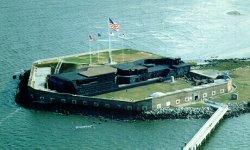
I recently visited Charleston, South Carolina where Tracy is busy learning about her new employer. Charleston is a beautiful scenic town, with a lot of great seafood restaurants featuring the local shrimp and she-crab.Our one site-seeing activity was a visit to Fort Sumter. Fort Sumter is known as the location of the "Battle of Fort Sumter" of April 12 and 13, 1861, or more specifically, the first battle of The Civil War.
I found the story of this little island fascinating, and believe it to be thematically relevant to our present crisis. Fort Sumter is a man made island commissioned by the Army core of engineers directly in response to the war of 1812. It was in 1812, that the British had marched into Washington and burned the most symbolic structure of our government, The Whitehouse. Were it not for rain, the entire city of Washington might have burned. Subsequently, the US military began to examine it's vulnerabilities, and in particular begun to look for ways to address their lack of naval capacity, and the direct threat this presented to the internal safety of the nation.
A report by the Army in 1827 recommended that the government build an island in the middle of Charleston bay and erect a Fort there, because it would allow for bombardment of incoming ships approaching the city of Charleston in a crossfire fashion in combination from either nearby Fort Moltrie on the northwestern shore or Fort Johnson to the east. Thus began a thirty year project to move tons of grannite and shells as the basis of the island, and erect a pentagonal Fortress with walls Fifty feet high and twelve feet thick. Some 30 years later, like many a Federal project, the fort was overbudget, overdue, and still not completed in 1861, although it was certainly close to that state, and was partially armed and stocked.Major Robert Anderson was the commander of the local garrison when South Carolina became the first state to seceed from the union, in response to the election of Abraham Lincoln as the first Republican President of the United States. South Carolina began the process of requesting transfer of federal properties and forts to their control, while an uneasy truce still existed between southern confederacy officials and lame duck president James Buchanan who hoped to avoid armed conflict, believing that mediation and compromise would keep the other southern states from joining the confederacy, and eventually draw the dissenters back into the union.
He did however, order Anderson to hold Federal properties, using his existing garrison (of only around 65 men, not counting the 12 or so musicians who filled out the ranks), an outlandish propostion, considering that the facilities in question were not forts, but rather installations for the purpose of bombarding foreign enemies who wished to attack Charleston by sea. On the evening of of December 26, 1860 Anderson having been refused reinforcements, did the only thing he felt reasonable, and moved his garrison to Sumter.
A ballistics expert and instructor at West Point, he knew that the island would not be easily compromised, since it was built at a distance a mile and a half from shore at the limits of prevailling artillery technology of the day, and with walls constructed specifically to withstand shelling by incoming warships.
South Carolina immediately began to protest this move as an act of aggression and hostility, and seized all the surrounding facilities, leaving Sumter as the last encampment in South Carolina still under federal control. When an effort in january to resupply the fort was repelled by shelling from the shoreline forts, Sumter quickly became a focal point and symbol of the conflict in both the north and the south, along with Fort Pickens in Florida.
To local residents, and to the governor of the state, the occupation of South Carolina territory only three miles from Charleston was a slap in the face. While it might have been northern grannite that created the island upon which it rested, it was the bricks baked in southern plantation ovens, which built the walls of the Fort. And the Fort itself was of considerable strategic value to whomever controlled it.
The Confederate military opposition in Charleston was under the command of a New Orleans born ex-us army soldier General Pierre Gustave Toutant Beauregard. Beauregard attempted to negotiate for the peaceful surrender of the Fort in the months and weeks prior to the battle, and had every expectation of success, since Anderson was not only a fellow Southerner (born in Kentucky) and known to be sympathetic to the concerns of the southern states, but in fact was both a friend and mentor to Beauregard. Beauregard had been a student in Anderson's West Point ballistics class, and the two had fought together in the U.S.- Mexican war of 1846-1848. It was Anderson's Southern background and sympathetic disposition that had landed him his command in Charleston precisely because Buchanan knew Anderson would avoid conflict in every way possible.
Having received word that Lincoln had dispatched a reinforcement operation to further entrench Ft. Sumter. Beauregard issued a final ultimatum that Anderson abandon the fort, and when he refused, began to shell Sumter from the surrounding Forts on April 12th. After a night of intense shelling, the fort was beaten but uncompromised. Unfortunately, being incomplete in construction and with only a few of the intended cannons installed, the Fort was not in a position to make much more than a token return of fire. On the 13th, Beauregard switched to "hot shot", solid iron shot, heated in a furnace. Hot shot furnaces were available since the purpose of this technique was to set fire to wooden ships. As the inner section of the fort was not entirely finished, it was the hot shot that set exposed wooden walls ablaze, and fearing that this would lead to an explosion of the powder rooms stocked full of gun powder, Anderson had no choice but to surrender after 34 hours of continuous shelling, where Fort Moltrie alone had fired 2500 some rounds at Sumter. Though shaken, not a single casualty was sustained by Anderson's Garrison, and they were summarily evacuated to New York and arrived as heroes admired in the North and South alike for their honorable efforts in the face of overwhelming odds.
Sadly, Sumter became the kindling that ignited smoldering passions on both sides, leading to the secession of additional southern states, and the splitting of Virginia from it's Western region (creating west virginia) because of the desire of the majority of residents in that part of the state to remain in the union.
Public pressure to engage the southern states and force them back into the union lead to the Battle of Bull Run, Virginia on July 21st, and quickly escalated into what would become four years of intense bloody battles, 620,000 deaths in battle or from disease, and the assassination of Lincoln on April 14, 1865 only 5 days after Lee's surrender at the Appomattox Courthouse.
Through the course of the war, despite repeated efforts by Union Forces and a naval blockade, they were never able to retake Sumter, and it did indeed prove to be invaluable in guarding Charleston harbor from naval attack, and protecting the city of Charleston.
Paoli to Savannah Sat, Jul 28. 2001
We recently took a small vacation while back east for a friend's wedding in Pennsylvania. Gizmo put in a tour of duty as postal delivery monitor. You can click on the photo to see it fullsize. Our trip took us to Hilton Head, SC and a day trip to Savannah, Georgia. If you've read the book or seen the film Midnight in the Garden of Good and Evil, you may recognize the Italianate mansion behind Tracy as the Mercer House on 429 Bull Street.
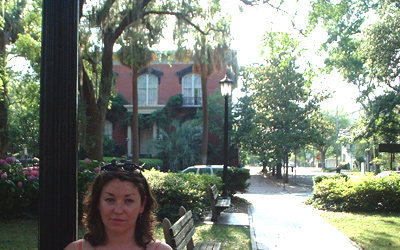
This was the home of the central figure of the book, Jim Williams, the now famous location of his huge Christmas Parties, and where he was alleged to have shot and killed his assistant Danny Hansford. "Historic" Savannah has a number of these courtyards, surrounded by residences. Ironically, the events of the book and film occurred in 1981, and it was not until 1994 when the book was published that Savannah began to enjoy an increase in tourism.
The famous bird girl statue featured iconically on the cover of the book originally marked a grave in the Bonaventure Cemetery, but was removed by the owners probably because it became the subject of so much interest after the book became a best seller. A Plaster cast of it now resides in the Savannah History Museum, apparently only 3 of the statues were ever made. Warner Bros still has a decent site built for Clint Eastwood's movie adaptation of the book that includes a map and description of the featured locations, and production notes.
During our short stay, it became obvious that aside from it's historic interest, Savannah's main tourist attraction is the waterfront area, along River street where many bars, restaurants, art galleries and shops can be found. Restaurants were packed, as people dined in the many terraces with a view of the Savannah river. In true southern fashion, it's legal to carry and consume an alcoholic beverage as you as you walk about town, and frozen concoctions can be proccurred at a number of bars. We spent a few hours there browsing the local galleries, bars, and candy stores. and eventually found the white-furr otter shown here. The sculpture is made of wood and is about two feet tall, the handiwork of an artist named Weir who specializes in a number of varieties of similar animal sculptures. We had them ship him to us, and he now occupies a corner of our living room next to the fireplace. Muckraking online Sat, Jun 23. 2001
The Internet is rampant with conspiracy theorists and websites devoted to revealing "the truth" about all sorts of topics from "Extraterrestrials" to the coverup of "Bill Clinton's out of control cocaine addiction." Part of the fun can be attempting to seperate the truth from the fiction. And so we come to the strange and possibly true story of one Bob Kolody and his 4 billion dollar lawsuit against the Coca Cola company: "But if some of those shareholders knew the story that you are about to read, they would have good reason to question Coca-Cola Chairman Doug Daft about Bob Kolody. They would be fascinated to know that for the past four years Coke has employed one of the country’s top intellectual property lawyers to defend a case that it has never identified in its annual SEC filings. What’s more, the $4 billion lawsuit has gone totally unreported by a national media that has, of late, reveled in the prospect of major U.S. corporations involved in trials that could cost hundreds of millions of dollars in damages."
Read the fascinating story of Bob Kolody at the online mudracking site Guerillanews.com and decide for yourself.

« previous page
(Page 1 of 1, totaling 6 entries)
next page »